The warehouse, this unknown… Guide to warehouse management
What is a warehouse? To many, it might seem like just a mysterious place where items rest before embarking on their journey to the final destination, a large shed full of boxes and pallets, with people and machines constantly moving without any semblance of logic… but is it really so? In reality, warehouse management represents the beating heart of logistics, the behind-the-scenes of every purchase we make, the place where products patiently wait to be chosen, used, or shipped.
Let’s see what makes warehouse management so special and why we must consider it one of the fundamental elements within the entire supply chain.
First of all, some definitions that can be found online:
A warehouse is defined as “a place for the storage and preservation of large quantities of goods and materials of all kinds” (Dizionario-italiano.it), or as “that logistical structure capable of receiving goods, storing them (stocking), and making them available for sorting, shipping, and delivery” (Wikipedia).
These definitions are quite similar to each other and all highlight the primary function of warehouse management: storing and organizing goods.
Warehouse management involves several fundamental elements. First of all, there is the physical structure, the building or facility that houses the warehouse. Then we find the necessary equipment to carry out various activities, such as handling equipment, manual or electric (forklifts), fixed equipment (shelves), and electronic devices (PCs, printers, mobile terminals). Finally, essential is the presence of people (workforce), who perform all operational activities.
Warehouse management can vary based on the type of goods stored and the role it plays within the supply chain. There are indeed “factory warehouses,” which store materials intended for the production departments of a plant. Often, in addition to the warehouse for production materials, there are also temporary warehouses for finished products awaiting shipment.
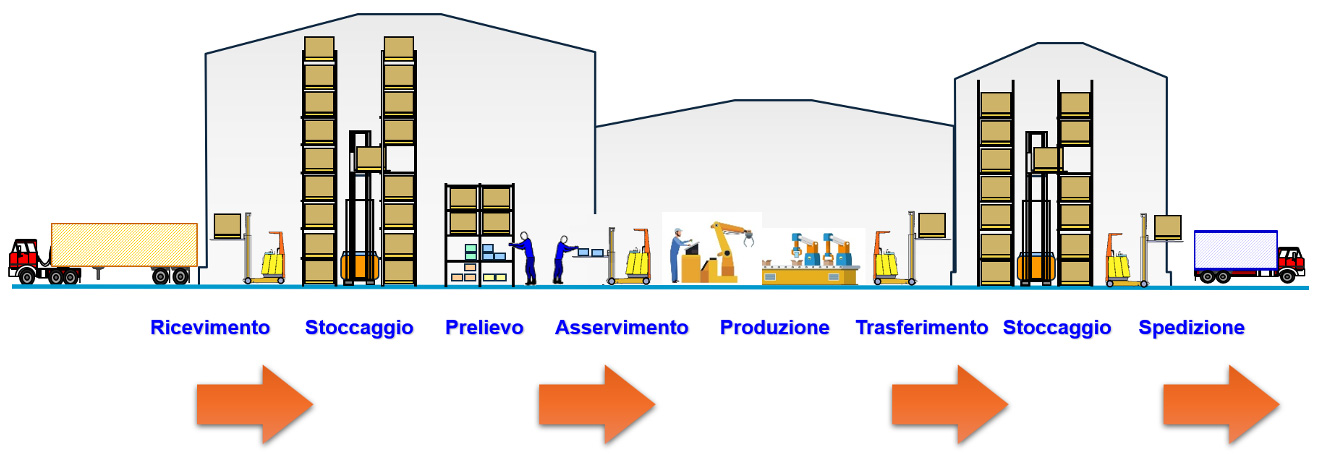
Then there are “distribution warehouses,” exclusively aimed at containing finished products and distributed along the supply chain. A common example is the Ce.Di (Distribution Center), very common in the Organized Large Distribution (GDO) chain.
In warehouse management, goods can be of very different nature:
- Raw materials or crude materials, stored in specific structures such as tanks and silos, or in more manageable containers like “big bag” sacks, tanks, and barrels.
- Semi-finished materials or components, protected during transport and storage in cartons, plastic, wood, or iron boxes.
- Finished products, intended for end users, which may require special storage conditions (cold rooms, rooms for food or hazardous products).
- Packaging material, used to protect and package finished products and which can be used internally or shipped to external customers.
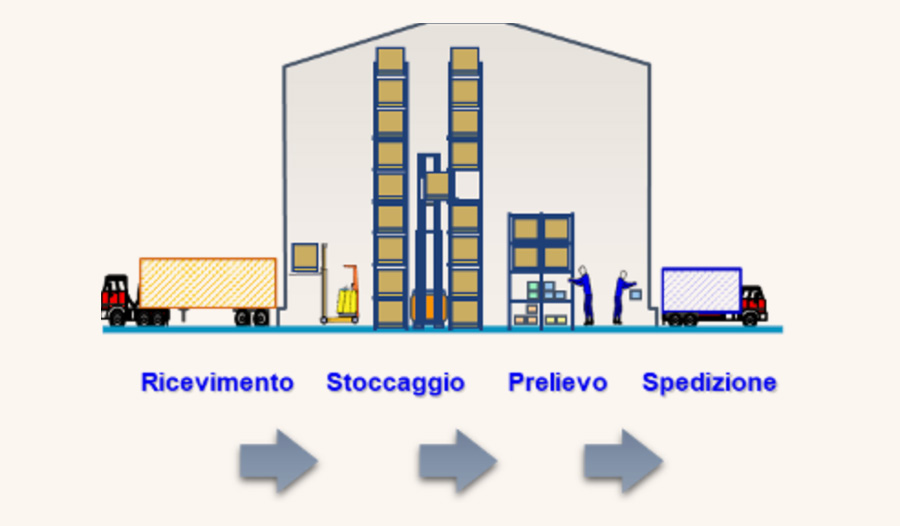
Warehouse management involves a series of fundamental operational processes:
- Receiving and acceptance of goods
- Stocking, that is, the storage of goods in suitable and safe support structures
- Picking, i.e., the selective selection of quantities requested by customers
- Supplying production lines, if a factory warehouse is present
- Packaging of goods before the shipping phase
- Shipping to final customers (distribution warehouses)
For correct and effective warehouse management, it is important to follow precise organizational and operational rules: clear definition of roles (organizational chart), detailed description of operators’ tasks (job description), standardized operating procedures (Standard Operating Procedures), quality control and maintenance, and strict compliance with safety and hygiene regulations.
These and other topics related to warehouse management will be explored in upcoming articles… stay tuned!

Articoli Correlati
The warehouse, this unknown… Guide to warehouse management
What is a warehouse? To many, it might seem like just a mysterious place where items rest before embarking on their journey to the final destination, a large shed full of boxes and pallets, with people and machines constantly moving without any semblance of logic… but is it really so? In reality, warehouse management represents the beating heart of logistics, the behind-the-scenes of every purchase we make, the place where products patiently wait to be chosen, used, or shipped.
Let’s see what makes warehouse management so special and why we must consider it one of the fundamental elements within the entire supply chain.
First of all, some definitions that can be found online:
A warehouse is defined as “a place for the storage and preservation of large quantities of goods and materials of all kinds” (Dizionario-italiano.it), or as “that logistical structure capable of receiving goods, storing them (stocking), and making them available for sorting, shipping, and delivery” (Wikipedia).
These definitions are quite similar to each other and all highlight the primary function of warehouse management: storing and organizing goods.
Warehouse management involves several fundamental elements. First of all, there is the physical structure, the building or facility that houses the warehouse. Then we find the necessary equipment to carry out various activities, such as handling equipment, manual or electric (forklifts), fixed equipment (shelves), and electronic devices (PCs, printers, mobile terminals). Finally, essential is the presence of people (workforce), who perform all operational activities.
Warehouse management can vary based on the type of goods stored and the role it plays within the supply chain. There are indeed “factory warehouses,” which store materials intended for the production departments of a plant. Often, in addition to the warehouse for production materials, there are also temporary warehouses for finished products awaiting shipment.
Then there are “distribution warehouses,” exclusively aimed at containing finished products and distributed along the supply chain. A common example is the Ce.Di (Distribution Center), very common in the Organized Large Distribution (GDO) chain.
In warehouse management, goods can be of very different nature:
- Raw materials or crude materials, stored in specific structures such as tanks and silos, or in more manageable containers like “big bag” sacks, tanks, and barrels.
- Semi-finished materials or components, protected during transport and storage in cartons, plastic, wood, or iron boxes.
- Finished products, intended for end users, which may require special storage conditions (cold rooms, rooms for food or hazardous products).
- Packaging material, used to protect and package finished products and which can be used internally or shipped to external customers.
Warehouse management involves a series of fundamental operational processes:
- Receiving and acceptance of goods
- Stocking, that is, the storage of goods in suitable and safe support structures
- Picking, i.e., the selective selection of quantities requested by customers
- Supplying production lines, if a factory warehouse is present
- Packaging of goods before the shipping phase
- Shipping to final customers (distribution warehouses)
For correct and effective warehouse management, it is important to follow precise organizational and operational rules: clear definition of roles (organizational chart), detailed description of operators’ tasks (job description), standardized operating procedures (Standard Operating Procedures), quality control and maintenance, and strict compliance with safety and hygiene regulations.
These and other topics related to warehouse management will be explored in upcoming articles… stay tuned!